


What Should Be Considered in Traffic Sign Design?
Clear and effective traffic sign design is essential to ensure that drivers traveling at legal speeds can quickly understand the intended message. To achieve this, signs must be visible from a proper distance and feature simple content, optimized layout, sufficient illumination, and reflective materials for night-time visibility.
Cost-efficiency is another important factor during the design and production process. Among all design elements, legibility plays a key role. This largely depends on the size of the letters used. In addition, color contrast, font style, and background selection significantly impact how well a traffic sign communicates its message.
The effectiveness of a traffic signs in delivering its intended message largely depends on its color, size, and installation location. While a large sign in any color might appear prominent, poor positioning—especially in space-limited urban areas—can significantly reduce its impact. Proper traffic sign design is a fundamental part of road and traffic engineering. Roads that lack well-designed, standardized signage are often considered unsafe and inefficient by modern infrastructure standards. Without proper signage, a roadway cannot fully meet the expectations of safety and performance in today’s transportation systems. To buy traffic signs contact us.

Delivering the Message in Seconds
Effective traffic sign design focuses on delivering clear messages to drivers in the shortest possible time. To achieve this, the use of simple, symbolic graphics is often the most efficient approach. Symbols can be processed quickly, reducing the time needed to interpret the sign and helping drivers respond safely.
However, in situations where additional explanation is needed, short and easy-to-understand words should be used. Overly complex text can distract drivers and increase the risk of accidents due to delayed reactions or confusion.
Using abbreviations on signs is generally not recommended, as it requires drivers to recall specific meanings that may not be universally understood. In high-stress or fast-paced driving conditions, this extra step can slow down decision-making and reduce the effectiveness of the sign. Abbreviations should only be used when their meaning is clear and widely recognized.
The placement of traffic signs is just as important as the message itself. Signs must be installed where drivers can see and process them in time to take appropriate action. If placed too early, a sign might be ignored or forgotten. If placed too late, the driver may not have enough time to react, which can lead to dangerous situations.
All traffic signs must be designed and installed according to relevant standards and regulations. Following these principles is essential for improving road safety and minimizing the risk of accidents. These are fundamental practices in the field of traffic engineering.
Recommended Read: Why Iran is Becoming a Leading Supplier of Traffic Signs and Safety Barriers in the Middle East
Consistency in Traffic Sign Design Across the Country
Maintaining a consistent approach to traffic sign design across the entire country is essential for road safety. When signs follow the same design standards—regardless of the region—drivers can quickly recognize and respond to them without hesitation.
Uniform traffic sign design includes consistent use of shapes, colors, and symbols. This helps reduce confusion, improves reaction times, and ensures drivers don’t have to relearn sign meanings when traveling between cities or regions.
A standardized approach to traffic sign design is a core principle in traffic engineering and plays a critical role in minimizing accidents and keeping roads safe nationwide.

Using Shapes, Colors, and Reflectivity in Traffic Sign Design
An important principle in traffic sign design is the use of different shapes and colors to categorize various types of signs. This visual distinction helps drivers quickly understand the sign’s purpose without needing to read the text in detail.
For example, warning signs are typically designed in a triangular shape, which drivers instinctively recognize as a cautionary signal. Regulatory signs, guidance signs, and informational signs also follow specific shape and color conventions to make interpretation faster and easier.
Another critical aspect of traffic sign design is nighttime visibility. Signs must be made with reflective materials to ensure they remain visible in low-light or nighttime conditions. The ability to see and understand a sign clearly after dark is just as important as during the day, especially for preventing accidents and ensuring smooth traffic flow.
Proper use of shape, color, and reflectivity makes traffic signs more effective, improving both driver awareness and overall road safety.

Using High-Quality Materials in Traffic Sign Design
In designing traffic signs, it is essential to use high-quality materials such as steel and aluminum. These signs are exposed to various weather conditions that can cause corrosion and rust over time. However, signs made from premium materials offer greater durability and resistance against these challenges.
Traffic signs must also remain visible during nighttime or low-light conditions. To ensure this, they are equipped with lighting features. This can be achieved either through internal or external light sources or by using reflective materials that enhance visibility by reflecting ambient light. Choosing the right materials and lighting solutions is a key part of effective traffic sign design, ensuring signs are long-lasting and clearly visible in all conditions.
In general, it is recommended that all warning, regulatory, and directional signs located more than 50 meters away from an electric light source remain illuminated throughout all hours of darkness. This gradual requirement ensures that signs near main power sources stay lit for better visibility.
Signs that are kept illuminated should also be retroreflective, so they remain visible in case of a power outage. In locations where signs are not illuminated, they must be made with reflective materials to ensure visibility. Therefore, all traffic signs should incorporate reflectivity as a fundamental feature. This practice is essential in effective traffic sign design to maintain safety and clear communication during nighttime or low-light conditions.
Helpful Read: Difference Between Conventional & High-Reflective Traffic Signs

Bilingual Traffic Sign Design: Using Multiple Languages
In areas with diverse populations or international visitors, incorporating multiple languages on traffic signs is essential for clear communication. Bilingual or multilingual traffic sign design ensures that drivers from different backgrounds can quickly and accurately understand important information.
Effective design balances readability and clarity, avoiding clutter while presenting messages in both languages. This approach increases inclusivity, improves navigation, and enhances overall road safety.

Function and Classification of Traffic Signs
Traffic signs and signals are essential and practical equipment on roads that play a crucial role in protecting drivers’ lives and property. Without these signs, the risk of accidents and hazards increases significantly.
Because of their importance, traffic signs are designed in various styles and categorized into three main groups to make them easier for drivers to understand. These three common categories of traffic signs include:

Warning Signs
Warning signs are typically designed in a triangular shape with a red border. The background of these signs is usually white, and the triangle’s point faces upward. When drivers see these warning signs on the road, they understand that there is a potential hazard ahead and should proceed with extra caution. However, not all warning signs follow the triangular shape. There are seven specific warning signs that use different shapes but still serve the sole purpose of alerting drivers to potential dangers.
The consistent design of warning signs is a crucial element of effective traffic sign design, helping drivers recognize and respond to hazards quickly and safely.
Regulatory Signs
Regulatory signs are usually designed in a circular shape with a red border. Generally, these signs are used to indicate prohibitions or restrictions on specific actions. However, not all regulatory signs are circular. For example, the stop sign is designed as an octagon, while the yield sign is an equilateral triangle pointing downward—both of which belong to this category.
In addition, regulatory signs may include supplementary plates below the main sign to provide additional information and help convey the message more clearly. The consistent design and use of shapes and colors are essential elements of effective traffic sign design, ensuring drivers understand and comply with road rules.
Guide Signs
Guide signs, which are commonly installed on most roads, typically aim to provide general recommendations to drivers. These signs are usually designed in colors like yellow, white, blue, green, and others. Most guide signs are square or rectangular in shape, but some directional signs feature a pointed end. This category includes both mandatory informational signs and advisory signs, which convey specific instructions or recommendations to drivers.
Effective traffic sign design ensures that guide signs communicate their messages clearly, helping drivers make informed decisions while navigating.

Key Considerations for Traffic Sign Placement
To ensure drivers receive specific messages from traffic signs in a timely manner, it is essential not only to focus on the design of traffic signs but also to pay special attention to their proper placement. There are various factors to consider regarding the installation of traffic signs, and neglecting these can lead to different hazards on the roads. Key aspects to keep in mind when placing traffic signs include:

1. Installation Location
To ensure that drivers receive the intended message from a traffic sign or safety signal at the right time, signs must be installed at an appropriate distance and location. Generally, this distance depends on the speed at which drivers are expected to travel along the road. All traffic signs are designed to convey specific messages and therefore must be visible from a long distance. The installation distance and position are determined based on the type of road and the typical speeds of vehicles, ensuring that drivers have enough time to see, understand, and react safely.
A very important point in traffic sign design is that signs should be installed in locations where they are clearly visible and readable from a long distance. This allows drivers enough time to recognize the sign and respond appropriately. Generally, drivers are accustomed to seeing signs on the right side of the road, so most essential signs should be placed there. However, there are exceptions—for example, on right-hand curves, placing signs on the left side may provide better visibility and safer conditions.
2. Sign Orientation and Positioning
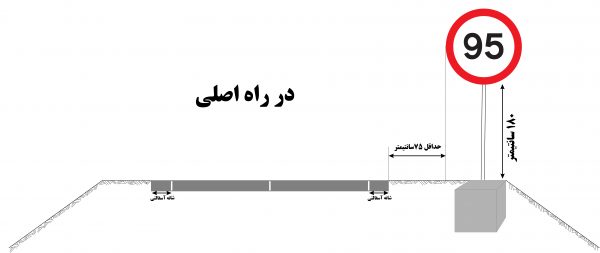
On arterial roads with medians, such as highways, traffic signs should be positioned so that their edges are at least 120 centimeters away from the pavement edge. In areas where the road shoulder is paved, this distance should be at least 75 centimeters.
For other types of roads, all signs must be installed with a minimum distance of 75 centimeters from the pavement edge. On roads with sharp curves, signs should be placed on the median strip, maintaining a minimum distance of 100 centimeters. For example, the installation distance for regulatory signs from the pavement edge follows these guidelines to ensure safety and visibility.
3. Installation Height
The installation height of traffic signs is extremely important. Signs should be mounted so that the bottom edge is at least 150 centimeters above the highest point nearby. In areas with buildings, signs usually need to be installed at a higher elevation. For example, when signs are placed on sidewalks, they must be positioned to allow enough clearance for pedestrians to pass safely.
Generally, the minimum recommended height for sign installation is 210 centimeters, but in some cases, it can be increased to 240 centimeters. Of course, the exact installation height varies depending on the type of road and countries standard. Proper height is a crucial aspect of traffic sign design to ensure visibility and safety for all road users.
4.Sign Facing Direction
In urban areas, excessive reflectivity can sometimes cause glare and distract drivers. For this reason, signs in city environments should be installed at angles that minimize reflection and enhance readability. On the other hand, for rural and highway settings, high reflectivity is essential—signs must remain visible from a distance at night so that drivers have enough time to react appropriately. Speed limit cancellation signs, for example, should always be installed at the exact point where the restriction ends, clearly marking the transition.
To attract the driver’s attention effectively, each sign must be placed at an optimal distance and angle within the driver’s line of sight. Determining the exact placement and orientation requires careful analysis of road length and expected vehicle speeds along the route. This ensures that the signs serve their purpose without causing confusion or delay in driver response. Proper alignment and reflectivity are both critical aspects of traffic sign design, especially in varied lighting and driving conditions.
Benefits of Installing Traffic Signs
One of the most important advantages of installing traffic signs is the significant increase in road safety. A thoughtful and effective traffic sign design plays a crucial role in preventing accidents and guiding drivers in the right direction. Without these signs, drivers would be left guessing about key information—such as how fast they’re allowed to drive, when to stop, or what road conditions lie ahead. The absence of clear signage can lead to confusion, delayed reactions, and a much higher risk of accidents.
Traffic signs help establish order on the road and give drivers the information they need to make quick, safe decisions. That’s why their proper placement and design are considered fundamental elements of modern road infrastructure.
There are always a few drivers on the road who behave unpredictably or carelessly. Unfortunately, their actions don’t just put themselves at risk—they also endanger everyone else sharing the road.
This is where effective traffic sign design becomes critically important. Well-designed signs deliver clear, predefined messages that all drivers can understand quickly. When signs are properly placed and easy to recognize, they give responsible drivers enough time to react appropriately—even in situations caused by others’ unsafe behavior. Traffic signs act as silent guides, helping maintain order and minimize the risks created by unexpected driver actions. A key objective in traffic sign design is to prevent accidents before they happen. To achieve this, signs must be designed and positioned in a way that grabs the driver’s attention and delivers critical information fast—allowing enough time to respond safely.
When traffic signs follow proper design standards, they help reduce the risk of collisions—whether between vehicles or involving pedestrians and cyclists. This leads to safer roads for everyone and protects both lives and property. Clear, well-placed signs act as an early warning system, making roads more predictable and helping drivers navigate safely through changing road conditions.
Pricing of Different Types of Traffic Signs
Today, various companies and manufacturers across the country design and produce traffic signs and road signals. As a result, the market offers signs under different brands and quality levels. Therefore, prices for traffic signs vary widely and are not fixed. When purchasing traffic signs, it’s important to consider several factors to determine a fair price. These include the raw materials used, product quality, brand reputation, and the details of the traffic sign design. Simply choosing based on price alone is not recommended, as some manufacturers may offer low-quality products at high prices.
It’s essential to first evaluate the quality of the product and ensure the design meets safety and visibility standards. Only then should you select a traffic sign that balances quality and cost effectively. One of the leading manufacturers in the country is Gartal Azin Naghsh, known for producing high-quality traffic signs and poles at competitive prices. For inquiries and orders, you can contact us at +98 914 422 0646.

Buying Guide for Traffic Signs
Nowadays, purchasing any product has become much easier compared to the past. People can quickly find detailed information about various products on trusted websites and even buy online. This convenience also applies to traffic signs and road signals. You don’t have to visit physical stores to buy traffic signs anymore — many reputable online shops offer a wide range of signs with reliable traffic sign design and quality. By choosing a trusted online store, you can order the exact signs you need at your convenience, saving time and effort.
Gartal Company is one of the leading manufacturers and suppliers of various traffic signs and road signals. By offering high-quality and durable products, the company enables you to purchase standard traffic signs with competitive prices.
To buy, simply visit Gartal’s website, review the product specifications and quality, and place your order easily. If you need more information or expert advice, you can also contact our specialists for guidance. These services ensure you make a confident and informed purchase, getting the best traffic sign design products for your needs.
Conclusion
Traffic signs and signals are among the most important equipment on the roads, playing a vital role in ensuring safety. Therefore, their traffic sign design must be clear and easily recognizable so that drivers can understand the intended message in the shortest possible time. If the design principles of traffic signs are not properly followed, the signs may not meet standards and could cause various problems on the roads. Nowadays, many manufacturers produce these signs, so when purchasing, you should pay close attention to their type, material, and design to ensure you select the best product for your needs.


